

Both keep your money safe and earning interest. The right choice comes down to one question: how soon will you need it?
Key Takeaways
- A savings account keeps your money accessible at any time, which makes it ideal for an emergency fund.
- A CD locks your money away for a set term in exchange for a higher, fixed interest rate, which makes it a good fit for goals with a known date.
- Both savings accounts and CDs are FDIC insured up to $250,000 per depositor, per ownership category.
- A CD ladder lets you blend the two, keeping part of your money liquid while the rest earns higher CD rates.
When you are choosing between a savings account and a certificate of deposit (CD), the decision really comes down to two things: when you might need access to your money, and the interest rate you will earn. A savings account keeps your money available at any time. With a CD, you trade immediate access for an interest rate that is typically higher than a savings account offers.
The good news is that whichever you choose, either option is covered by the Federal Deposit Insurance Corporation (FDIC) in the unlikely event of a bank failure. Your deposits are insured up to $250,000 per depositor, per ownership category. Savings, CDs, and checking accounts you hold in the same ownership category are added together toward that limit. If you have an Individual Retirement Account (IRA) or a Health Savings Account (HSA) with us, any portion held in cash or CDs is covered as well, in its own ownership category.
To help you compare, let us look at what each account offers and how it might fit your plans. It really comes down to flexibility versus commitment.

What a Savings Account Is
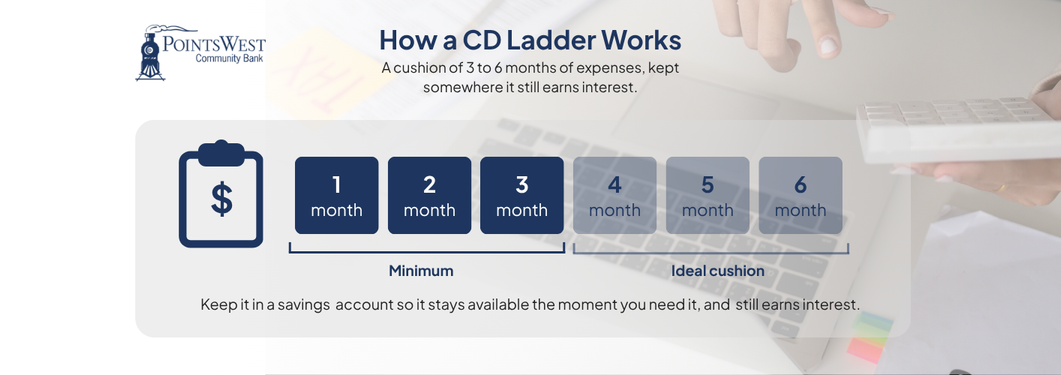
A savings account is a safe, secure place to hold your money while earning monthly interest on your balance. It is a great option if you might need to reach your money at any time, which makes it a natural home for your emergency fund. Financial experts generally recommend keeping three to six months of household expenses set aside for emergencies, ideally somewhere it can still earn interest. Many of our customers have their paycheck deposited into checking and set up automatic transfers into savings, which makes putting money aside for a rainy day effortless.
Savings Account Alternatives
There are also a few alternatives worth knowing about. If your employer offers a high-deductible health plan, you may be eligible for a Health Savings Account (HSA), which lets you set aside part of your income on a pretax basis, so you do not pay income tax on what you contribute. Like a 401(k), those funds can be invested, and you can use them for qualified healthcare costs such as deductibles and prescriptions. A traditional Individual Retirement Account (IRA) or a Roth IRA is another option if your goal is saving for retirement.
What a CD Is
A certificate of deposit (CD) is a type of savings account where you agree to leave your money untouched for a set term in exchange for a higher interest rate than a traditional savings account typically offers. At Points West, we offer CD terms ranging from three months to five years, and generally, the longer the term, the higher the rate. When a CD reaches the end of its term, you can roll the funds into a new CD or move them to your savings or checking account.
With a Points West CD, you have a grace period to make that decision. If we do not hear from you within that time, your funds are automatically re-enrolled in a CD for the same term, at whatever rate market conditions support at that point. Keep in mind that withdrawing your money before the CD reaches term means an early-withdrawal penalty, so it is best to choose a term that lines up with when you will need the funds.
Side-by-Side: The Trade-Offs That Actually Matter
When you are weighing a savings account against a CD, the choice usually comes down to how soon you will need your money, the rate you want to earn, and where you think interest rates are headed. Here is a quick comparison:
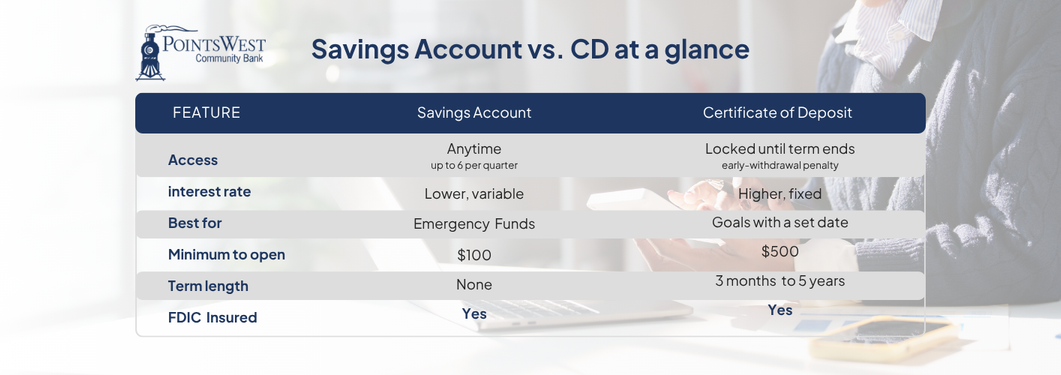
| Feature | Savings Account | Certificate of Deposit (CD) |
| Access to funds | Available anytime (up to six withdrawals per quarter) | Locked in until the term ends; early-withdrawal penalty applies |
| Interest rate | Lower, and can change over time | Higher, and fixed for the full term |
| Best for | Emergency funds and money you may need at any moment | Money set aside for a goal with a known date |
| Minimum to open | $100 | Dependent upon the CD term and current rate offerings |
| Term length | None | Three months to five years |
| FDIC insured | Yes, up to $250,000 per ownership category | Yes, up to $250,000 per ownership category |
Predicting where interest rates are headed is difficult even for seasoned economists, and conditions can shift without notice, so we will not try to call it for you. That said, some customers tell us that when they expect rates to fall, they lean toward a CD so they can lock in today’s rate for a term anywhere from three to 60 months (five years). When they expect rates to rise, they lean toward a savings account or a shorter-term CD that frees up sooner.
Access matters too. If you are saving toward a specific goal, such as a down payment on a home or another planned expense, you might choose a CD that matures right around the time you will need the money.
Minimums are worth a look as well. Our savings accounts open with just $100 and are free, with six free withdrawals per quarter (every three months). If your balance drops below $100, a $3.00 monthly service fee applies. A CD requires a $500 minimum deposit to open.

Which Is Right for You?
Customers whose savings are mostly a three- to six-month emergency fund tend to keep all or most of it in a savings account, so they can tap into it whenever they need to while still earning interest. Customers who are saving toward a particular goal with a date in mind, such as a major purchase or an event, tend to favor CDs.
What’s a CD Ladder?
You do not always have to pick just one. A strategy called a CD ladder lets you blend both. Say you have an emergency fund: you might keep part of it in your savings account for quick, easy access, then split the rest across CDs of different term lengths. As each CD reaches term, you can move the funds into savings or re-enroll them into a new CD at whatever term works best for you. You stay liquid where you need to be, while the rest of your money earns higher CD rates.
Where Points West Fits
We offer both CDs and savings accounts at competitive rates, and we are happy to help you find the right mix. If you are not sure where to start, one of our local bankers can walk you through the options, talk through your goals, and help you decide. Because we are a community bank, that conversation happens with someone who knows the area where you live and work.
Talk with a Points West Banker Today
Not sure which one fits? Take a look at Points West’s current CD specials, or talk with a local banker who can help you match the right account to your goal. Schedule a conversation with a Points West local banker at your nearest branch.